 AI Tools
 Health
 Math
Math Everyday Life
 Finance
 Physics
 Chemistry
 Statistics
 Construction
 Pets
Pets Time & Date
 Conversion Calculator
 Sign In
Pages
Category
Follow Us On:
Pages
Category
Follow Us On:
Finding the distance around a circle might seem tricky at first. But once you know the simple relationships and a few practical tricks, you can do it with confidence, whether you have a ruler, a picture, or just a number from a problem. This guide walks you through easy language and clear steps, showing every common method people use to find the circumference. It also helps you understand which approach fits different situations so you can pick the one that works best for you.
What Circumference Means And Why It Matters
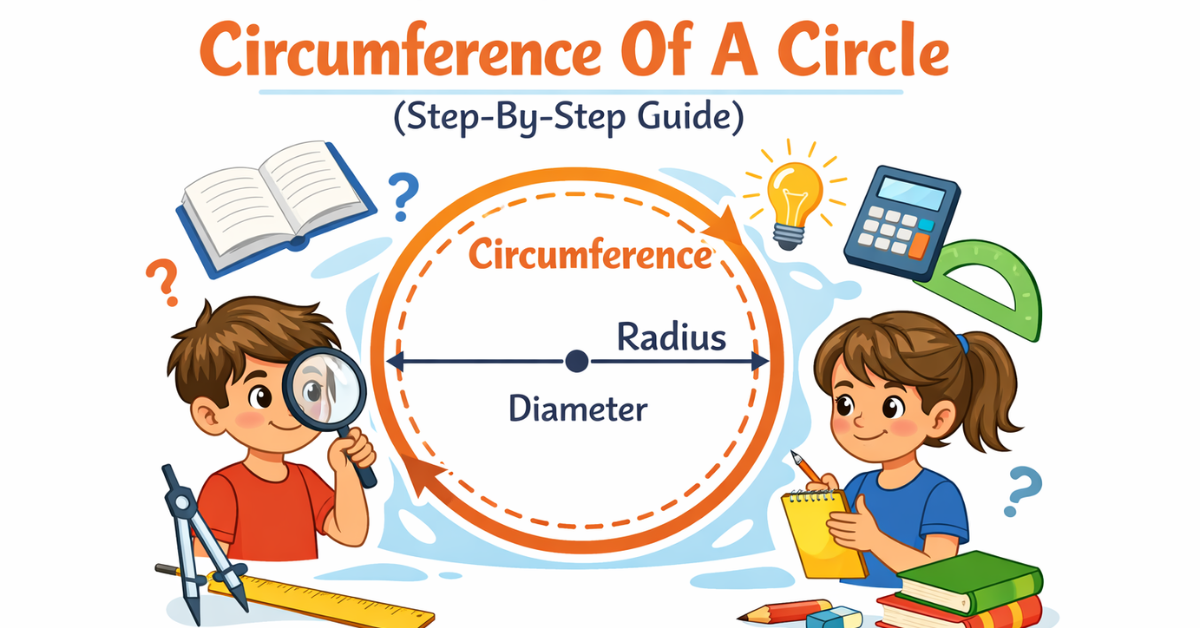
Circumference is the length of the outer edge of a circle, and you can think of it like the circle’s perimeter, which helps you measure things like paint needed for a round tabletop.
To calculate the circumference of a circle, you usually need either the diameter or the radius, and you will use the number pi, written as π, which we treat as 3.14159 in most practical work.
The Basic Circumference Formula You Need
The circle circumference formula comes in two simple forms, so you can choose what matches your measurement.
If you know the diameter, use
C = π × d
If you know the radius, use
C = 2 × π × r
These two equations are the same idea written two ways because the diameter equals two times the radius. These formulas make it easy to calculate the circumference using the diameter or calculate circumference using radius, depending on what you can easily measure.
Use Diameter Or Radius First When Possible
When you can measure straight across the circle, the diameter method feels fastest because you multiply that one number by π, and you are done. This is the reason why lots of people find it better to measure the diameter to obtain the fast result.
However, when you can measure the distance between the center and the edge of a circular object, then the radius method can be an excellent choice. The only difference in this method is that you will just multiply the radius by 2 and the rest formula will be the same. Whichever formula you follow to compute the circle circumference, you will always get the same answer.
Find Circumference From Area Or Arc Information
There are also times when only the area of a circle is provided, but not the radius or diameter. Here you must first derive the radius by the formula of area which is A=πr2. As soon as you get the value of the radius, it will be easy to obtain the circumference of a circle through the common formula, C=2πr.
When you have an arc length and its central angle, you can get the entire circumference by comparing that angle with 360 degrees. Because one full circle consists of 360 degrees, you can scale the arc length with the angle and get the complete length of the circle.
Measure Physically With a String or a Tape
In case you are using a real object, the easiest method of determining the circumference distance is by using a string or a tape. To begin with, take a string and wrap it around that physical object until it gets back to the starting point. Then mark that point where the string meets the starting point, and then measure the length of the string to that point.
By so doing, it becomes easy to determine the value of the circumference of a physical object without having to go through the formulas and calculations. The technique is also very effective when it comes to the calculation of the circumference of irregular edges or objects.
Use Geometry Tricks From Chords And Angles
If you have a chord length and the corresponding central angle, you can compute the radius through geometry and then go to the usual formulas. This helps when you work from partial measurements. Similarly, if you have scale drawings, measure the circle in the drawing and scale your answer up. Because proportion keeps the relationship between the diameter, radius, and circumference intact.
Practical Tips For Accurate Results
Measure twice when you can, keep units consistent so you do not mix centimeters and inches. Use more π decimals when you need precision. If you want to teach someone the process, walk through one example using the circle circumference formula. Then try a different example that asks you to calculate the circumference using the diameter and one that asks you to calculate the circumference using the radius. So the learner sees both forms.
Closing Note!
No matter which method you choose, the result stays the same. The circumference is always linked with the radius or diameter through π. You can find the circumference by measuring with a string, working from the area or arc, or using an online tool to verify your answer. With a little practice, you will find that it’s very easy to calculate the circumference of any circular object.

Last updated: December 31, 2025
Shelby Steve is a skillful writer and an Engineer; He has taken a degree in Electrical Engineering and is a professional Research analyst and writer. He is a passionate writer and expert in Niches like Mathematics, Physics, Chemistry, etc. He is an expert in communicating his point of view in the most descriptive manner.


Recent Posts
Links
Home Conversion Calculator About Calculator Online Blog Hire Us Knowledge Base Sitemap Sitemap TwoEmail us at
Contact Us© Copyrights 2026 by Calculator-Online.net
How was your experience today?
Not now
Awesome! Would you mind sharing that on Trustpilot?
Your review helps others find a tool that actually works.
Write a Review on TrustpilotNot now
Sorry to hear that
Tell us what went wrong — we read every message.
Not now
Thanks for your feedback!
We'll use it to make things better.