
 AI Tools
 Health
 Math
 Everyday Life
 Finance
 Physics
 Chemistry
 Statistics
 Construction
 Pets
 Time & Date
 Conversion Calculator
 Sign In
Follow Us On:
Follow Us On:
Approximate solutions to first-order differential equations from initial conditions, using a step size (h) or number of steps (n).
Related
Use this Euler’s Method Calculator to approximate the solution of a first-order ordinary differential equation (ODE), dy/dx = f(x, y). Enter the initial condition (x₀, y₀), the target x-value, and either the step size (h) or the number of steps (n) to calculate the approximate solution with step-by-step calculations.
“The Euler method is a first-order numerical method used to solve ordinary differential equations (ODEs) with specific initial values”
Developed by Swiss mathematician Leonhard Euler, this method estimates the solution at successive points using the function's slope and a specified step size.
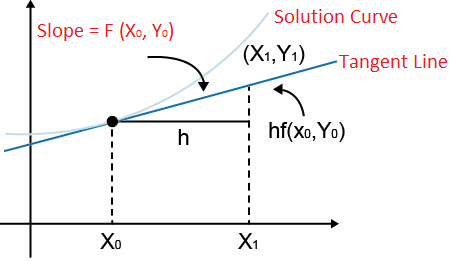
yn+1 = yn + h · f(xn, yn)
Within the equation:
Let's look at the following example to understand how to apply Euler’s method step by step:
Example:
Use Euler's Method with a step size of h = 1 to approximate the value of x(4) for the following initial value problem:
From the initial condition x(0) = 1, we know:
We will use these values to calculate x(t) at each successive step until t = 4.
xₙ₊₁ = xₙ + h × f(tₙ, xₙ)
For this problem, the differential equation is:
x'(t) = x(t)
Therefore, the function used in Euler's formula is:
f(t, x) = x
So, Euler's method equation becomes:
xₙ₊₁ = xₙ + h × xₙ
Since h = 1:
xₙ₊₁ = xₙ + xₙ
At each step, we use the current values of tₙ and xₙ to calculate the next value, xₙ₊₁.
Starting with t₀ = 0 and x₀ = 1, apply Euler's Method repeatedly until t = 4.
For the first iteration:
x₁ = x₀ + h × f(t₀, x₀)
x₁ = 1 + 1 × 1 = 2
We then use t₁ = 1 and x₁ = 2 to calculate x₂. The same process is repeated until t = 4.
| Iteration (n) | tn | xn | f(tn, xn) | xn+1 |
| 0 | 0 | 1 | f(0,1) = 1 | 1 + 1×1 = 2 |
| 1 | 1 | 2 | f(1,2) = 2 | 2 + 1×2 = 4 |
| 2 | 2 | 4 | f(2,4) = 4 | 4 + 1×4 = 8 |
| 3 | 3 | 8 | f(3,8) = 8 | 8 + 1×8 = 16 |
After four iterations, we reach t = 4.
Using Euler's Method with a step size of h = 1, the approximate value of x(4) is:
x(4) ≈ 16
⇒ Therefore, the Euler's Method approximation is ≈ 16.
Try our Euler’s Method Calculator for quick results. Follow the steps below to enter your equation and get an approximate solution.
Follow these simple steps to use the Euler’s method calculator accurately:
Euler’s method is used to calculate the approximate numerical solutions to first-order ordinary differential equations (ODEs). This technique is used when the initial conditions are given, and an exact analytical solution is difficult to find.
Euler’s method is called a first-order method because its global error is directly proportional to the step size (h), meaning the error decreases linearly as h is made smaller.
The value of “h” for Euler's method should be smaller for higher accuracy and stability. But it is necessary to keep its value large enough to avoid extra calculations in computing small quantities.
Yes, Euler’s method can be used for any higher-order ODE. But first, convert them to first-order differential equations and then use Euler's method to solve the higher-order ODE.
Not directly, as the standard Euler’s Method Formula is basically used for Ordinary Differential Equations (ODEs). However, PDEs are solved using the Forward Euler finite difference method combined with finite-difference approximations, can be used to solve PDEs.
Related
Add this calculator to your site.
×Just copy a given code & paste it right now into your website HTML (source) for suitable page.
Preview:



Easter into Action, Save With Satisfaction
UPTO
50 %
OFF
Give Us Your Feedback
Share Result
Euler's Method Calculator

Links
Home Conversion Calculator About Calculator Online Blog Hire Us Knowledge Base Sitemap Sitemap TwoEmail us at
Contact Us© Copyrights 2026 by Calculator-Online.net
How was your experience today?
Not now
Awesome! Would you mind sharing that on Trustpilot?
Your review helps others find a tool that actually works.
Write a Review on TrustpilotNot now
Sorry to hear that
Tell us what went wrong — we read every message.
Not now
Thanks for your feedback!
We'll use it to make things better.
